Saturday, July 15, 2023

The Temple of Literature - Also Vietnam's First University @ Hanoi [Vietnam]

I am hesitating if I should break up the post of The Temple of Literature into numerous postings as there were over a hundred photos of this historical place of attraction in Hanoi. but decided to suck it up as there are a lot of backlog!

Let's queue up to purchase the tickets! Easily one of the top attractions in the capital city, the queue wasn't too long even though there was only one counter, and ticket pricing was only about S$1.70 per adult.

Now the five-color flags; I remember that the colour of the center, either red or orange, would determine if it's a religious temple, known as pagoda, or temples for the royalty. Isn't orange another shade of red? 

Official entrance of The Temple of Literature, which was built in year 1070 to honor Confucius but also to served as the imperial academy from 1076 to 1779 (over 700 years) to "educate Vietnam's bureaucrats, nobles, royalty, and other members of the elite". 

Bronze bell at the main gate was installed in the 18th century and said to be touched only by monks. Whatever the case, members of public didn't seem to be able to go up. 

Centre path was reserved for the monarch and high ranking officials in the past but now, it's the ticketed entrance for everyone! Check out the carvings of two dragons on top of the archway. 

Ancient structure marred by modern technology with ugly wirings necessary to power the CCTVs and the ticketed gantries. I think it can be improved although I am one to always enjoy modern conveniences. 

First out of five courtyards - known as the Nhap Dao, or Entrance of the Way, it was built in 19th century during the Nguyen dynasty. 

Information plaque in Vietnamese, English and French! In case some of you are unaware, Vietnam was colonized by the French, resulting in many influences, including banh mi, and that some of the older generation in Vietnam is able to hold a conversation in French.

Majestic tree and ponds. To be honest, it's quiet and serene, although boring for high strung individuals like me who are always on the lookout for something special. 

Main gate which bore signs of wear and tear that added to the charm, I feel. The two doors flanking the center path appeared to be the staircase leading to the second floor, where the bell was.

From what I read online, this was still part of the first courtyard. 

Second Courtyard - similar to the first courtyard, the Thanh Dat courtyard had trees and ponds although I am guessing a lot of people would get ready to take out a Vietnamese note to take photos. 

This particular square-like structure, the Khuê Văn pavilion, was featured on the back of the 100,000 Vietnamese dong! It's known to be the icon of Hanoi and was built in 1805.

Even though I am a history student, the thought running through my mind then was whether I can climb up. p.s. I understand Chinese but not when they were sentenced in a poetic manner, with meaning that wasn't as straightforward. 

Third Courtyard - Thiên Quang Well, which was in my honest opinion, just a much larger pond. It has a nice name though, the Well of Heavenly Clarity. 

Square -shaped, it was said to function as a mirror, both to observe the essence of the sky and for students of the past to ensure they were dressed properly before stepping into the sacred courtyards beyond the third.

My friends and travel mates! 
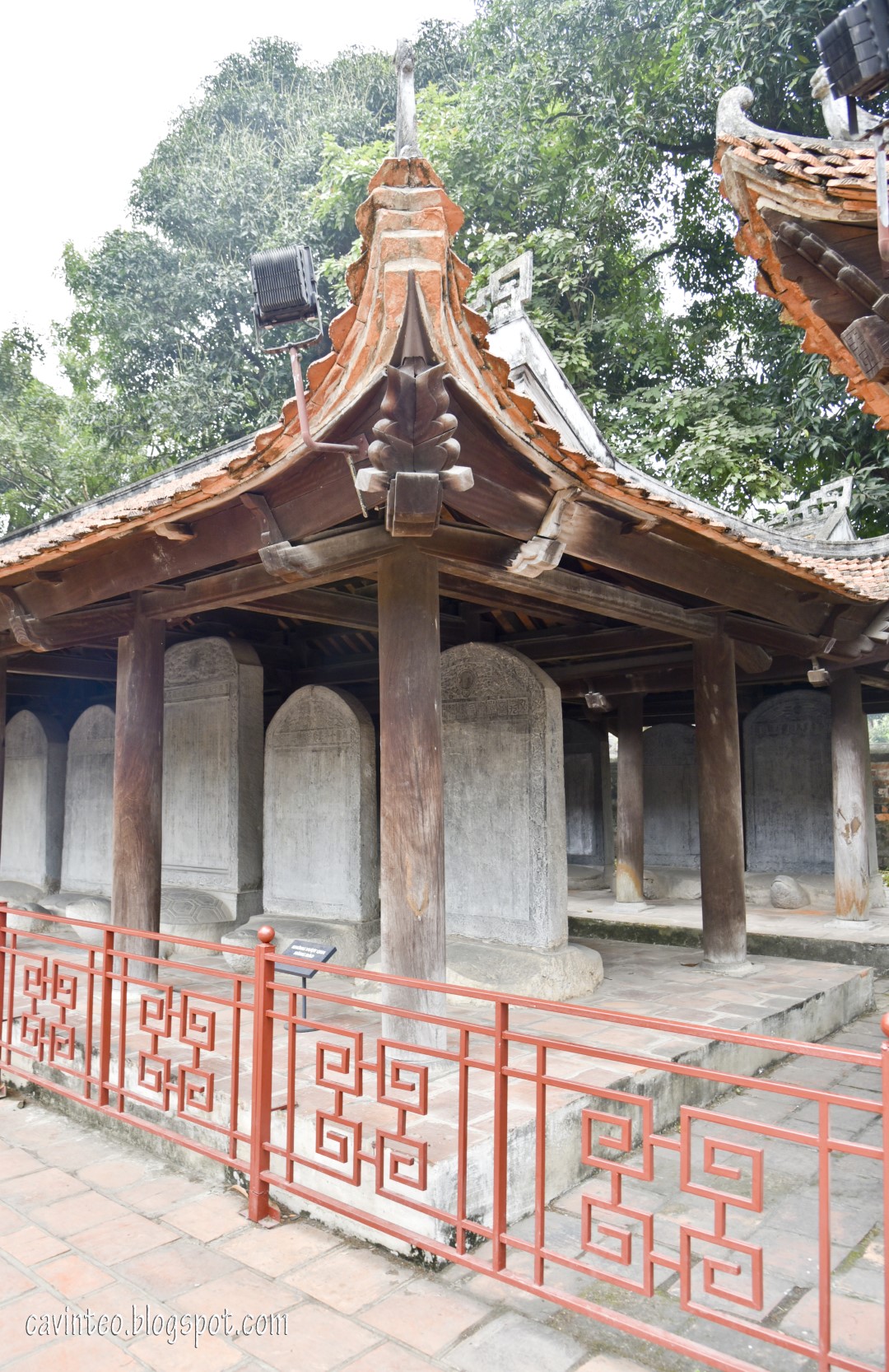
Garden of the Stelae - flanking both sides of the Well of Heavenly Clarity were 82 life sized stone plaques that I initially thought were tombstones!

Placed on top of tortoise pedestals, the stones stated the names and birthplaces of 1307 graduates over 82 exams that took place every three years  from 1442 to 1779, and included merits of the monarch and "records of  the mandarins who were tasked with organizing the exams".

There were supposed to be 116 of them but the reduction was a result of wars over the wars. To be frank, to have so many to be able to survive so long is already quite a feat! 

Forging towards the fourth courtyard! 
Through the Đại Thành Gate! 

Fourth Courtyard - expansive, ceremonial heart of the temple as this courtyard housed the actual temple of literature, where Confucius, the philosopher, is honored.

That large metal urn in the middle caught the attention of some.
Nosy me had to go over to see what's in store.

Intricate designs with three dragon hearts on top, with two arching dragons on the side that seemed to be holding the urn! Honestly, I didn't know the purpose of this since it didn't have any space to stick incense sticks. 

Peering in between the slits.
Looks like it had become a donation box!

Items found in the courtyard, numerous bonsai plants and a family of lions with a funny, surprised expression. Don't think they were here for a few hundred years.

Souvenir stall selling items I could usually find in Singapore's Chinatown. Having said that, I admit I didn't exactly take a closer look, which I should in case there were gems amongst them.

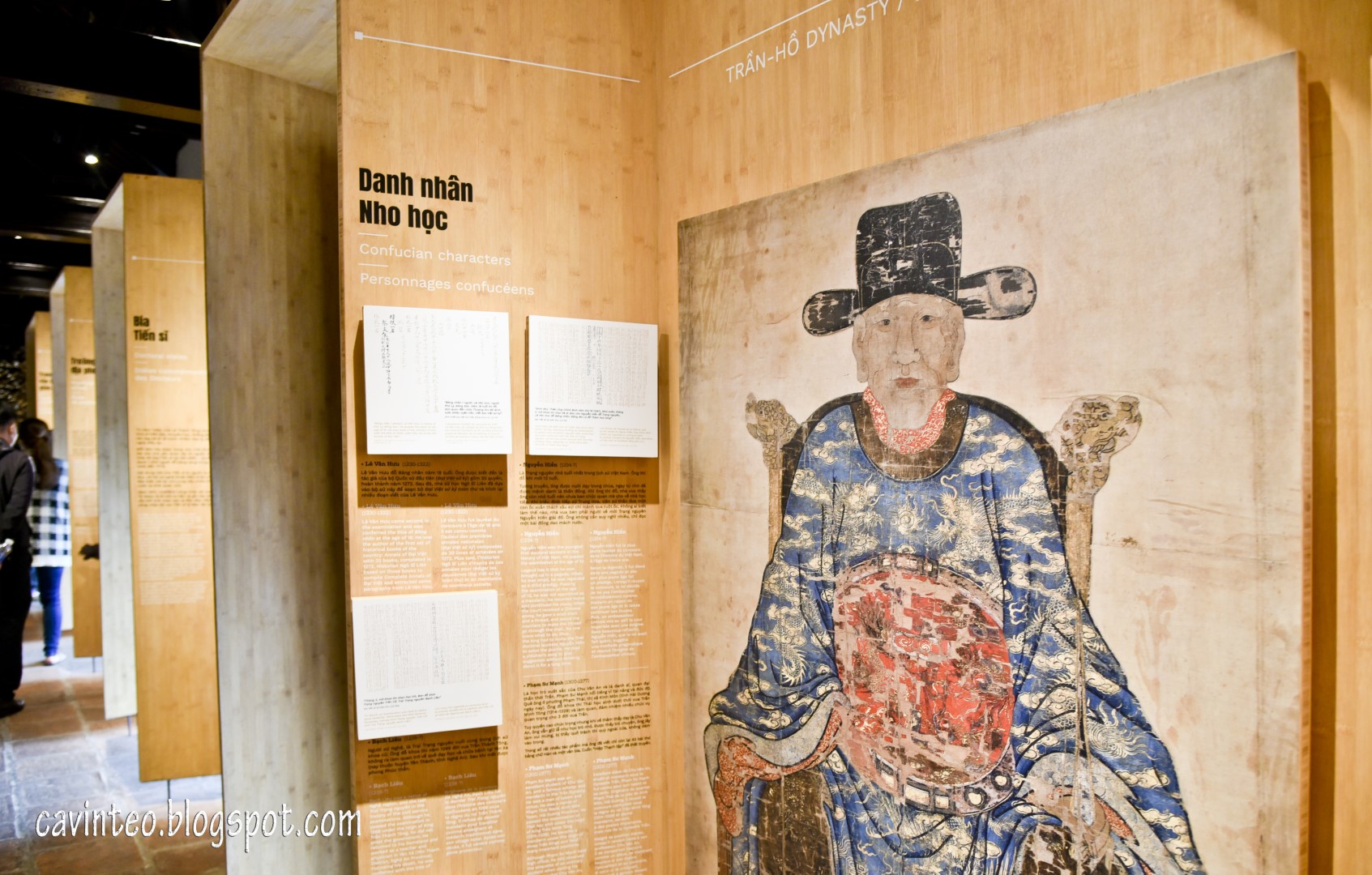
On the sides of the courtyard were two single storey buildings; one of which was an exhibition with the name "the first national school".

Snippets of information about The Temple of Literature, its history, notable Confucian scholars, the management, the developments over the years, including refurbishment, reconstruction etc, to maintain this historical, cultural relic. 

I was more interested in the maps! p.s. personally, I found the exhibition to be quite messy and I didn't quite know where to start. Thing is, I bet you can spend a relatively long time here if you are interested in history.

The other single storey building flanking the courtyard contained a stall where you can have Chinese calligraphy on a scroll. You can choose suitable Chinese characters from a booklet. Click here to find out more. 

Right next door would be the heritage discovery centre.

Like a traditional printer for books in ancient Hanoi, including posters on information like teaching, Confucian examinations in the past, how to honor candidates in the past etc.

Time to step into the building right in front after after walking through Đại Thành Gate. This building is known as the Great Hall of Ceremonies.

To me, great infers a huge hall but it wasn't to be. The so-called hall was long but not exactly deep, with just one altar right in the centre, which seemed to honor all teachers.

Ever wondered why there were so many statues of cranes standing on tortoises in Vietnam? There's a story about a great friendship between this pair of unlikely individuals, and you can read more here

Another bell here. Guess it's a been a while since it was last hit, given the cobwebs, although I think visitors would still love to touch, given the discoloration. 

To the connecting hall at the back.

Urn for incense sticks. Dragons are the main decorative characters in Chinese temples and the design for the above dragons for the urn was the norm a few centuries ago, when the noses appeared stubbier,

Interior for this section, with red pillars, beams and windows!

This gentleman in the middle would be the great Chinese philosopher, Confucius. Called Van Tuyen Vuong in Vietnam, his works served as the basic of governance for many Chinese, Korean and Vietnamese dynasties. 

The four other statues flanking Confucius were said to be his four closest disciples, Yanhui, Zengshen, Zisi and Mencius. Out of the four, I have vaguely heard of Mencius only.

Robes of the four disciples had the same cloud pattern as the ones imprinted on the pillars for the structure! Funny for me as I have a low threshold for humor. 

I believe these were the altars of other leading scholars of Confucianism. In fast-paced, modernized Singapore, philosophy is often misunderstood to be boring and impractical, which is a real pity as it's supposed to strengthen one's ability for problem solving given its analysis of definitions, concepts, arguments. 

Gold plated ceramic tortoise. Aside from tortoise, the other three sacred animals in Vietnam folklore would be dragon, phoenix and this unicorn-like animal known as qilin. 

Was there supposed to be some statue in this altar? 

Exquisite carvings on the wooden beams. Do note that the temple of literature went through numerous restorations over the past century and the last courtyard for the temple was in fact rebuilt in 1999.

Marker for audio guide.

Back to the main courtyard as my friends were missing! Turned out the Kon had engaged the calligrapher and was waiting for the completed works. 

So I walked around to take more pictures! Managed to capture this group of likely newly graduands , in graduation gowns, taking photo with the Well of Heavenly Clarity as the backdrop. Youth. 

Now proceeding to the fifth courtyard.

Fifth Courtyard - the imperial academy which was rebuilt in 1999 although they weren't exact replications, with architecture and design based on traditional imperial style. 

Random photo! Seated on Vietnamese red stools, the ladies were just relaxing and chatting among themselves and judging from the stacks of red stools at the side, I am assuming anyone can just take and sit around the courtyard. 

Front hall was the site of an exhibition showcasing what appeared to be the works of the French School of Asian Studies (EFEO), under the purview to "preserve outstanding pieces of heritage and study the originality of Vietnamese culture" in the early 20th century.

Straightaway, I identified this as the Garden of the Stelae although what caught my attention more was the street view outside the Temple of Literature.

Hall at the back of the imperial academy.

Bell tower; the bronze bell was "cast in 2000, with dimensions of 2.10 meters by 0.99 meters. It was barricaded so I guess only on special occasions would the bell be rung.

The other end would be the drum tower. According to Wikipedia, it is "2.01 meters wide, 2.65 meters high, with a volume of 10 m3 and weighs 700 kilograms"! That's a drum that can kill if it rolls over someone.

Urn filled with expended incense sticks. Are the incense sticks in Vietnam different as the ashes curled up instead of dropping? Maybe very high quality incense sticks.

Ground floor honored Chu Văn An, a former rector of the academy said to "had a strong influence on Vietnamese education for many centuries" and passed away in year 1370.

Interior of the hall. 
If I recalled correctly, it was rebuilt without a single nail. 

Scaled models of the Temple of Literature, including one that showed the period when the first courtyard wasn't even built yet. p.s. we didn't check out the pavilion on the left, which was more a garden opened to the public, with the need for a ticket.

Traditional attire; given the dragon embroidery, I am guessing the right one was for the king / emperor. Damn, I should have taken a clearer picture of the labels on the glass cabinet.

Let's climb up to the second floor! 

An opulent display with three altars dedicated to "three kings who contributed most to the foundation of the Temple of Literature and the development of Confucian development in Vietnam".

"Lý Thánh Tông (1023–1072), who founded the temple in 1070, Lý Nhân Tông (1066–1127), who founded the Imperial Academy, and Lê Thánh Tông (1442–1497), who ordered the erection of the turtle stone stelae of doctor laureates in 1484".

View on the second level.

Souvenir shop where you can get more unique souvenirs and / or interesting designs. Stuff would be more expensive given their uniqueness. 

Leaving by the side gate and concluding our visit. 

Well, we did throw a few stares from people but when you are with a crazy bunch, you tend to do somewhat crazy things! And I think I am pretty sane! 

=====

Address
58 P. Quốc Tử Giám, Văn Miếu, 
Đống Đa, Hà Nội, Vietnam

Map
As above.

Pricing
Adult - 30,000 Dong
Audio - 50,000 Dong 


Friday, July 14, 2023

Yao Yao Ping Restaurant @ Klang in Malaysia

When one travels, it's always beneficial to have a local friend and that's what we did for our inaugural trip to Klang, where we were brought to places popular with locals, and not inundated with foreigners! 

One of the places was this restaurant known as yao yao ping, which is directly translated to shake shake ice. I was pre-informed by the friend that it's an ice dessert that he visited since he was a child. I must admit that this friend is only about 20 over years and not exactly middle-aged like me.

My best description is that it's a cross between ice cream and shaved ice in the way that the shaved ice would pre-shave and with added flavorings before being compressed into ice cream-like tubs. 

It's like flavored ice with flavors like watermelon, pineapple, sour plum, red bean, bo bo char char and chendol. What I didn't realize is that I can choose to mix a few flavors into one cup!

Nevertheless, they were thirst quenching and refreshing under the extremely hot weather, and I didn't feel they were artificially flavored. I especially like my sour plum yao yao bing with the right balance of icy sourness and sweetness.

Forgot to share the dining area! Despite its coffee shop outlook, it was air-conditioned with fans bringing extra breeze to the interior. 

I noted there were other stalls in the restaurant and the first thing that caught my attention wasn't the shaved ice. It was the irresistible aroma of grilled chicken wing!  

Aside from the grilled chicken wing, I noted many tables had fried chicken too but I shouldn't overly indulged with my recent weight gain, although I did get the egg burger.

Grilled chicken wing was sadly average tasting even though it could have performed better if the stall operator had passed me one that was fresh from bring barbecued above the burning charcoal.  

Egg burger was okay too; just something I would purposely order if I were to revisit again. However, there's something that went so well with egg and chicken that I will make sure to have the fried chicken with it in my next visit.

The chilli! Despite being too fluid, it had a manageable spiciness that tasted like a mixture of chicken rice chill and sambal chilli. So glad it was given even though I didn't request for it.

Eh.... I saw a wanton mee stall too! I do enjoy the Malaysian style, black sauce wanton mee and at just RM 7 for a small portion, about  S$2.00, it was decided a small plate wouldn't do "much" harm. My logic can be so warped sometimes. 

Sweet, smooth and oily; the way they should be in Malaysia. Again, I think it was alright to fill the tummy but not when you are looking for the best wanton mee in Malaysia. 

Now, I feel so guilty for having so much as the rest didn't really want to share as we had just had bak kut teh at Samy not more than half an hour ago! 

=====

Address
1503, Jalan Young, Pandamaran, 
42000 Pelabuhan Klang, Selangor, Malaysia

Map
As above.

Thursday, July 13, 2023

Nasi Lemak Ayam Goreng from Village Park Restaurant @ Petaling Jaya in Malaysia

The way that Malaysian standup comedian,
Joanne Kam, lambasted the differences between Singapore style and Malaysia style nasi lemak motivated me to check out the most famous nasi lemak eatery when I was at Petaling Jaya (PJ) recently; Village Park Restaurant

Aside from the newspaper cuttings, I heard this place was also popular amongst Singaporeans; even my niece and nephew had tried it before. A fact I knew after returning back to Singapore from PJ. 

I was totally expecting a long queue on a Sunday afternoon and decided to check it out at close to 4.00 pm, before their official closing at 5.00 pm. No queue (except for delivery riders / driver awaiting from their orders), biy from the look of the trays of dishes; well, didn't seem to have much food for us too! 

Thankfully, there were still the ayam goreng, Malay for fried chicken! I didn't need much for nasi lemak, fried chicken with rice and egg would have been sufficient to curb my craving.

Despite the lack of a line outside the restaurant, the dining area was packed with customers! Guess there are many people like me, who like to avoid peak periods like lunch and dinner. Now, let's order quickly as I was absolutely famished! 

Nasi Lemak Ayam Goreng - there were eight types of nasi lemak (with options for chicken rendang, beef, prawns, sotong, fish etc) and I chose this as it was the first item on the list, and I can't resist fried chicken! 

In Singapore, the chicken in question would usually be drumstick or chicken wing, and not as luxurious as the whole chicken thigh as depicted in the above photo! That, to me, is already a winner! Hold your horses, let me take a bite first.

It was unbeatably delicious; juicy chicken infused strongly with rempah and blessed with a crispy crust! Adding on to that were the large, crunchy peanuts and a generous serving of sambal (I agreed with Joanne Kam; Singapore's sambal was so pathetically little) similar to those served in Malay nasi padang stalls which I thoroughly enjoyed! 

Leaving the best for the last; the thin, crisp fried chicken skin! Not everything was perfect; the rice was aromatic although it didn't quite commensurate with an intense coconut milk taste. The saving graces were that the rice wasn't oily and honestly, would still be considered as pretty good for Singapore's standard. 

But I admit, this Malaysia style nasi lemak is better than the ones in Singapore, more so when the price for it was only about S$3.60 after conversion! In Singapore, I would have to pay extra for the peanuts.  

p.s. extra sambal was chargeable at RM 0.80. I usually request for extra chilli in Singapore but the one at Village Park was sufficient for me. 

Damn, I should have purchased their bottles of sambal. It would have been nice with raw, cold cucumbers! Anyway, my PJ friend was telling me the nearby Say Yes Cafe had better nasi lemak; guess it's a good enough reason for me to pay another visit to PJ in the near future! 

=====

Address
5, Jalan SS 21/37, Damansara Utama,
47400 Petaling Jaya, Selangor, Malaysia

Map
As above. 

Operating Hours
6.30 am till 5.30 pm
(Daily)

Menu
As above.

Pricing
Nasi Lemak Ayam Goreng - RM 12.30
(Subject to Tax)